
A full schedule can hide a lot.
Patients are coming in. Hygiene is booked. The team is moving. Production is higher than it was last year.
From the outside, the practice looks healthy.
Then the owner gets to the end of the month—or the end of the year—and asks a much harder question:
If we’re producing more, why aren’t we keeping more?
That question is becoming increasingly important for independent dental practices because the economics underneath production have changed.
And one number helps explain why.
The 4-Point Margin Gap
According to the American Dental Association Health Policy Institute’s Q2 2026 State of the U.S. Dental Economy report, since January 2021:
- Dental equipment and supply prices increased 23%
- Hourly earnings for dental-office staff increased 23%
- Overall inflation increased 27%
- Provider reimbursement increased 19%
That leaves a four-percentage-point difference between two major practice-cost measures and reimbursement growth.
Four points does not sound dramatic.
That is exactly why it matters.
A sudden 20% decline gets everyone’s attention.
A gradual structural gap can disappear inside a growing production number.
The practice stays busy. Revenue can rise. The team works harder.
Yet the economics underneath each dollar collected become less forgiving.
The problem is not necessarily that the practice stopped producing.
The problem is that production alone does not tell you what the practice kept.
Production Tells You What You Did. It Doesn’t Tell You What You Kept.
Production is important.
But production cannot tell an owner whether all that activity is converting into sustainable profit.
A practice can produce more while simultaneously experiencing:
- higher labor costs,
- higher supply costs,
- slower collections,
- larger contractual adjustments,
- aging receivables,
- unreconciled write-offs,
- or an unfavorable payer mix.
That is where owners get trapped.
They watch the easiest number to see while the margin moves somewhere underneath it.
So the better question isn’t simply:
How much did we produce?
It’s:
What happened between production and the money we ultimately kept?
That is where management starts becoming dental practice governance.
Being Busy Doesn’t Solve the Problem
The same ADA report shows something else worth paying attention to.
About 28% of dentists said they were too busy to treat everyone requesting care.
At the same time, roughly 24% said they did not have enough patients.
That does not mean market demand is irrelevant.
Geography matters. Competition matters. Payer mix matters. Specialty matters. Patient demographics matter.
But the data does tell us something important:
There isn’t one national demand condition producing the same result for every practice.
One practice can be constrained by capacity while another needs patients.
And even a practice drowning in demand still has to turn that demand into collections—and collections into profit.
Being busy is not the same thing as being profitable.
Margin Pressure Is Becoming an Operating Issue
Dental leaders are increasingly describing the problem in operational terms.
In a September discussion reported by Becker’s Dental Review, Jaleh Pourhamidi, COO of Today’s Dental Network, described today’s margin work as requiring:
“micro-surgical precision to understand where the leakage is.”
The same discussion identified revenue-cycle management and staffing as two of the most controllable variables practices still have.
That language matters.
If the economic environment is less forgiving, the answer cannot simply be:
Produce more.
Eventually the practice has to know exactly where the money is getting lost.
Which payer? Which adjustment? Which aging bucket? Which provider? Which location? Which workflow?
And then the question that matters most:
Who owns fixing it?
Visibility finds the variance.
Governance determines what happens next.
Software Is Not Governance
This is where many practices make another mistake.
They recognize that visibility is poor, so they buy technology.
A dashboard. Another analytics platform. AI. A new revenue-cycle tool.
Technology can absolutely make a dental practice better.
But visibility and execution are not the same thing.
In the published description of an upcoming September 30 session on AI-era dental revenue-cycle management, Becker’s frames the issue directly: technology alone does not guarantee stronger RCM performance.
The framework instead emphasizes technology paired with robust processes, standardized governance structures and expert human oversight.
The metrics highlighted include collections, days in A/R, revenue leakage, and cost-to-collect.
That is the distinction independent owners need to understand.
A dashboard can tell you that A/R over 30 days increased.
Governance answers five additional questions:
- Who owns it?
- What is the standard?
- When is it reviewed?
- What variance triggers action?
- What happens when the number falls outside that standard?
Without those answers, the dashboard gives you information.
It does not give you management. That is the distinction behind how SAPRO’s operating model works: visibility matters, but ownership and response matter more.
The Gap Between Deciding and Doing
Insurance participation gives us another example.
Late in 2025, ADA HPI asked dentists about their plans for 2026.
Thirty-five percent said they intended to drop out of at least some insurance networks.
By Q2 2026, 23.5% reported that they had done so.
Those numbers don’t tell us why every remaining dentist hadn’t acted.
Some may have changed their strategy. Some may have needed more financial analysis. Some may have faced contractual timing issues. Some may have decided that staying in-network still made sense for their particular market.
But the numbers demonstrate something every operator recognizes:
Deciding and executing are two different operating events.
A decision without an owner can stall.
A decision without a deadline can drift.
A decision without a review cadence can disappear behind the next emergency.
And a decision without financial measurement leaves you unable to determine whether it actually improved the business.
That is where governance closes the gap.
What Dental Practice Governance Actually Looks Like
Governance does not mean turning an independent office into a bureaucracy.
It means removing ambiguity.
Take days in A/R.
The metric has a named owner.
It has an agreed standard.
It is reviewed on a specific cadence.
And there is a defined response when the metric moves outside the acceptable range.
Now do the same thing with collections, write-offs, revenue leakage, labor efficiency, treatment acceptance, payer performance, and cost-to-collect.
The system is simple:
Every important metric needs an owner, a cadence and a connection to the P&L.
That is what turns reporting into management.
Same Dashboard. Different Operating System.
Imagine two dental practices producing the same amount.
In the first practice, the owner receives reports.
A/R increased. Everybody sees it. Nobody knows exactly why.
Write-offs are visible. Nobody is responsible for identifying the pattern.
Payer reimbursement has changed. Nobody has reviewed the financial impact recently.
Problems get discussed when they finally become painful enough to reach the owner.
Now imagine the second practice.
Same data.
But every important variance has an owner.
A/R is reviewed on schedule. Adjustments are reconciled. Payer performance is evaluated. Labor and revenue are reviewed together.
When a number moves outside the agreed standard, somebody is expected to act.
Same dashboard.
Different operating system.
That difference becomes increasingly valuable when margins are tightening.
From Firefighter to Operator
There is a version of practice ownership where every morning starts with discovering what went wrong yesterday.
The owner is constantly reacting.
A staffing problem. A billing problem. A schedule problem. An insurance problem. A patient problem. Another fire.
Then there is a different version.
The owner walks into a system where the variance has already been identified.
Someone owns it. The standard is defined. The next action is clear.
That owner isn’t spending the day discovering problems.
That owner is managing performance.
The difference isn’t talent.
It isn’t hours.
It isn’t another dashboard.
It’s governance.
Why This Matters for Independent Dental Practices
Independent ownership should not mean operating without the disciplines larger organizations use.
In fact, the independent owner has something the DSO does not:
control.
You can move faster. You can make decisions without layers of corporate approval. You can preserve your culture. You can protect the doctor-patient relationship.
But independence becomes an advantage only when it is paired with operating discipline.
Otherwise, freedom becomes inconsistency.
The objective is not to become a DSO.
It is to install the parts of the DSO operating model that make businesses predictable:
- clear ownership,
- defined standards,
- regular review,
- financial accountability,
- and action when a variance appears.
DSO-level governance without giving up ownership.
The Four Points Aren’t the Whole Problem
The four-point cost-versus-reimbursement difference is not a calculation of your individual practice margin.
Your payer mix may be different. Your labor structure may be different. Your supply costs may be different. Your market may be different.
But it is a warning.
The environment has become less forgiving.
When the spread between costs and reimbursement narrows, the practice has less room for operational drift.
A write-off matters more. A stale fee schedule matters more. A claim sitting past 90 days matters more. Unused capacity matters more. Overstaffing matters more. Understaffing matters more. Treatment that never gets scheduled matters more.
The solution is not simply to work harder.
And it isn’t simply to produce more.
You need to know:
- Where is the variance?
- Who owns it?
- When will we review it?
- What are we going to do about it?
That is the operating discipline that protects dental practice profitability.
A 15-Minute Dental Practice Profitability Review
Owners do not need a new dashboard to begin. Start with one short operating review:
- Compare production to collections. Identify where activity is failing to convert into cash.
- Review A/R aging. Look at balances over 30, 60 and 90 days and identify who owns each exception.
- Review adjustments and write-offs. Look for recurring payer, provider or workflow patterns instead of isolated transactions.
- Compare labor to revenue. Determine whether staffing cost is moving with the economics of the practice.
- Assign the next action. Every meaningful variance should leave the meeting with an owner, deadline and review date.
If the same issue appears again next month with no assigned owner or defined response, the practice does not have a reporting problem. It has a governance problem.
| Metric | What to Review | Governance Question |
|---|---|---|
| Collections | Production-to-cash conversion | Who owns the variance? |
| Days in A/R | 30/60/90-day aging | What happens when the standard is missed? |
| Adjustments | Recurring payer/provider patterns | Is the cause documented and corrected? |
| Labor | Labor cost relative to revenue | Is staffing aligned with practice economics? |
| Treatment acceptance | Diagnosed treatment not scheduled | Who owns follow-up and by when? |
Frequently Asked Questions
Why is my dental practice busy but not profitable?
A busy schedule and growing production do not automatically create higher profitability. Labor, supply costs, reimbursement, payer mix, collections, write-offs and revenue-cycle performance all affect how much of production ultimately becomes retained profit.
What dental practice KPIs should an owner review?
The exact KPI set depends on the practice, but important measures can include collections, days in A/R, revenue leakage, cost-to-collect, labor efficiency, write-offs, treatment acceptance and payer performance. The metric matters less if nobody owns it or knows what action to take when it misses the standard.
Can software improve dental practice profitability?
Yes. Technology can improve visibility, workflow and efficiency. But software alone does not create accountability. Important metrics still need defined standards, named owners, review cadences and predetermined responses to unfavorable variances.
What is dental practice governance?
Dental practice governance is the management structure that defines who owns an important business metric, what acceptable performance looks like, how often it is reviewed and what action occurs when results move outside the agreed standard.
Stop Managing Production Alone
If your production is increasing but profitability still feels harder to protect, the problem may not be how much dentistry you are doing.
It may be what is happening between production and the P&L.
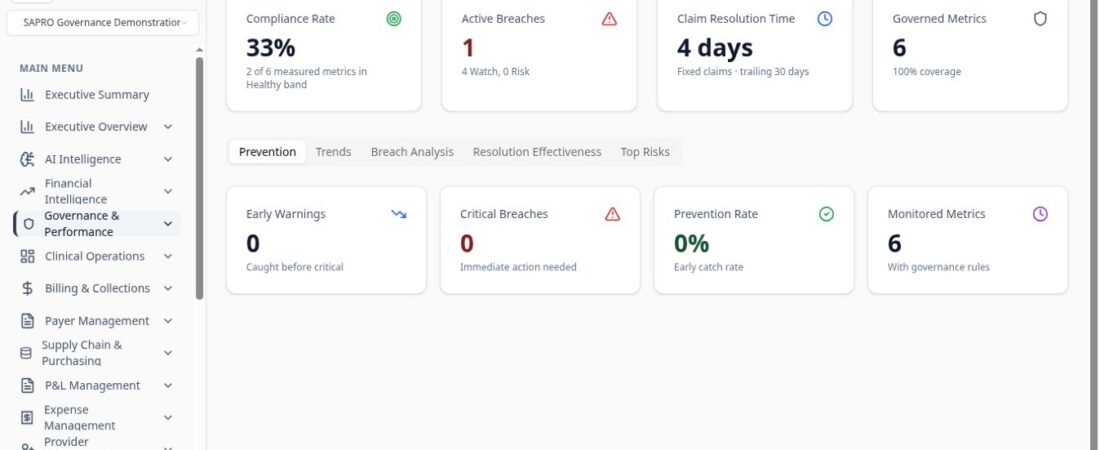
A SAPRO Governance Review examines the systems behind your revenue, labor and operating performance to identify where financial results are separating from activity—and whether someone actually owns the correction.
Run your practice like a DSO owner. Keep your independence.
Sources
- American Dental Association Health Policy Institute — State of the U.S. Dental Economy, Q2 2026 Update
- Becker’s Dental Review — Why the squeeze on dental margins is no longer temporary
- Becker’s Dental Review — 22% of dentists have dropped insurers so far in 2026
- Becker’s Hospital Review — RCM in the AI era: Why technology alone won’t get DSOs to scale